
In the dynamic landscape of modern commerce, businesses constantly grapple with the decision of how to best allocate their marketing resources. The perennial debate between digital marketing and traditional marketing is not merely a choice of channels but a strategic philosophical stance on connecting with consumers. Both methodologies possess distinct strengths and weaknesses, offering unique pathways to reach target audiences, build brands, and drive sales. Understanding these nuances is crucial for crafting an effective and sustainable marketing strategy.
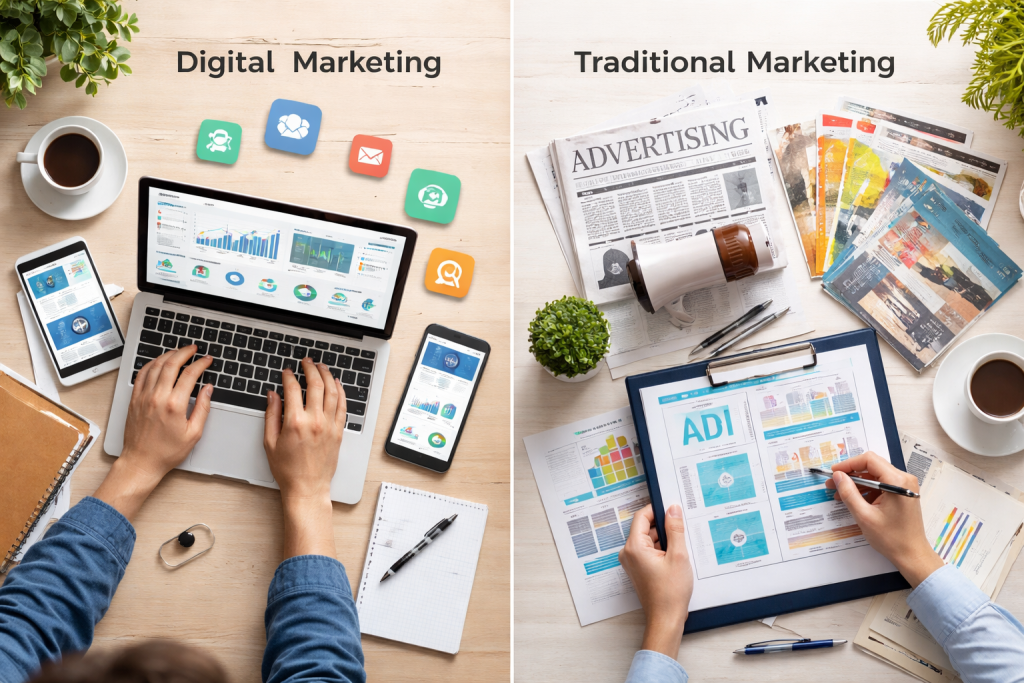
The fundamental objective of any marketing campaign is to reach the right people at the right time. The methods for achieving this widespread visibility and focused attention vary considerably between digital and traditional approaches.
Contents
- 1 Digital Marketing: Precision and Breadth
- 2 Traditional Marketing: Broad Strokes and Tangible Presence
- 3 Digital Marketing: Flexible Budgets and ROI Focus
- 4 Traditional Marketing: High Entry Barriers and Fixed Costs
- 5 Digital Marketing: Data-Rich and Real-Time Insights
- 6 Traditional Marketing: Indirect and Lagging Indicators
- 7 Digital Marketing: Two-Way Dialogue and Community Building
- 8 Traditional Marketing: One-Way Information Dissemination
- 9 Digital Marketing: Agility and Real-time Optimization
- 10 Traditional Marketing: Slow and Costly Adjustments
- 11 Digital Marketing: Authority and Authentic Storytelling
- 12 Traditional Marketing: Legacy and Trustworthiness
- 13 The Power of Combined Forces
Digital Marketing: Precision and Breadth
Digital marketing, encompassing everything from search engine optimization (SEO) and social media marketing to email campaigns and content marketing, excels in its ability to pinpoint specific demographics with unprecedented accuracy. Platforms like Google Ads and Meta’s advertising tools allow businesses to target potential customers based on interests, behaviors, demographics, location, and even past online interactions. This granular targeting minimizes wasted impressions and maximizes the likelihood of engaging genuinely interested individuals. The reach of digital marketing is also global and instantaneous, allowing businesses to connect with audiences across geographical boundaries without significant logistical hurdles. Furthermore, the sheer volume of data generated by digital interactions offers priceless perspectives on audience preferences, enabling continuous refinement of targeting strategies.
However, the proliferation of digital content also presents challenges. The digital landscape is intensely competitive and saturated, making it difficult for individual messages to cut through the noise. Ad blockers are widely used, and consumers are increasingly adept at filtering out unwanted digital advertisements, leading to what is often termed “banner blindness.” It can be challenging to establish genuine trust and attention in this environment, as it requires consistent effort and high-quality, relevant content to avoid being perceived as intrusive.
Traditional Marketing: Broad Strokes and Tangible Presence
Traditional marketing channels, such as television, radio, print media (newspapers, magazines), billboards, and direct mail, often reach a broader audience. A television commercial, for instance, can reach millions of viewers during a popular program, offering unparalleled mass exposure. Billboards, strategically placed in high-traffic areas, provide constant visibility to a diverse audience within a specific geographic region. The tangible nature of traditional marketing, such as a physical print advertisement or a direct mail piece, can also create a sense of legitimacy and permanence that digital advertisements sometimes lack. For many, a physical advertisement holds more weight and trust, especially in certain demographics.
Conversely, traditional marketing generally lacks the precise targeting capabilities of its digital counterpart. While a magazine might cater to a specific interest group, individual advertisements within it are seen by everyone who flips to that page, regardless of their immediate buying intent. The cost of traditional advertising, particularly for television and national print campaigns, can be prohibitively high, making it inaccessible for many small and medium-sized businesses. Measuring the exact reach and impact of traditional campaigns is also significantly more challenging and less precise, often relying on survey data and proxy metrics rather than direct observational data.
The financial outlay associated with marketing efforts is a critical consideration for any business. The cost-effectiveness of digital versus traditional advertising varies greatly depending on the campaign’s scale, goals, and target audience.
Digital Marketing: Flexible Budgets and ROI Focus
One of the most compelling advantages of digital marketing is its inherent flexibility in terms of budget. Businesses can start with modest investments, such as a small pay-per-click (PPC) campaign, and scale up as their budget and campaign performance allow. Many digital advertising models, like PPC, are performance-based, meaning businesses only pay when a specific action, such as a click or an impression, occurs. This allows for a more direct correlation between spending and measurable outcomes. The ability to A/B test various ad creatives, placements, and targeting parameters at minimal cost further enhances cost-effectiveness, enabling continuous optimization and improved return on investment (ROI). Furthermore, organic digital marketing efforts, such as SEO and content marketing, while requiring significant time and effort, can generate long-term, high-quality traffic without direct per-interaction costs.
However, the cost-effectiveness of digital marketing is not without its caveats. The constant need for content creation, search engine optimization, and platform management can incur ongoing labor costs. For competitive keywords and highly sought-after ad placements, the costs can escalate rapidly. Businesses also face the challenge of managing increasingly complex platforms and algorithms, often requiring specialized expertise or the hiring of digital marketing agencies, which adds to the overall expenditure. If campaigns are not consistently monitored and optimized, it can result in wasted ad spend and poor results.
Traditional Marketing: High Entry Barriers and Fixed Costs
Traditional marketing, particularly for media channels, typically involves a higher initial investment. The cost of producing a television commercial, purchasing airtime, or placing a full-page advertisement in a national newspaper can be substantial. These costs are often fixed, meaning a business pays the same amount regardless of how many people genuinely engage with the advertisement. This high barrier to entry can make traditional marketing inaccessible for startups and smaller businesses with limited budgets. The production costs for traditional materials, such as printing brochures or fabricating billboards, also contribute to the overall fixed expense.
While seemingly less cost-effective on a granular level, traditional marketing can achieve significant economies of scale for large corporations aiming for brand awareness among a broad audience. The perceived authority and trust associated with traditional media can also contribute to long-term brand equity, which, though difficult to quantify precisely, holds significant value. However, the lack of real-time adjustments and the inability to quickly pivot a campaign based on immediate data mean that if a traditional campaign underperforms, the financial losses can be substantial without immediate corrective action.
The ability to measure the effectiveness of marketing efforts is paramount for optimizing campaigns and demonstrating ROI. Digital marketing and traditional marketing offer vastly different capabilities in this regard.
Digital Marketing: Data-Rich and Real-Time Insights
Digital marketing stands as a paragon of measurable performance. Sophisticated analytics tools meticulously track and analyze every click, impression, conversion, and interaction. Websites, social media platforms, email marketing software, and advertising platforms provide real-time data on campaign performance, audience demographics, user behavior, and conversion rates. Businesses can see exactly which ads are performing best, where traffic is coming from, and how users are interacting with their content. This wealth of data allows for immediate adjustments to campaigns, continuous optimization, and precise calculation of ROI. A/B testing different headlines, creatives, and calls to action becomes a straightforward process, leading to data-driven decision-making and improved campaign efficiency.
However, the sheer volume of data can also be overwhelming. Interpreting complex analytics and extracting actionable insights often requires specialized skills and tools. There’s also the challenge of data privacy regulations and browser limitations, such as cookie restrictions, which can sometimes impact the comprehensiveness and accuracy of tracking. Furthermore, attributing conversions accurately across multiple digital touchpoints can be a complex endeavor, requiring advanced attribution models.
Traditional Marketing: Indirect and Lagging Indicators
Measuring the direct impact of traditional marketing campaigns is significantly more challenging. While methods like coupon codes, specific landing page URLs, or unique phone numbers can help track responses to print ads or radio spots, these are often indirect and retrospective. Brand recall surveys, sales data analysis post-campaign, or changes in foot traffic for brick-and-mortar stores are common metrics, but these provide a less precise and often delayed understanding of campaign effectiveness. It’s difficult to definitively attribute a sales increase solely to a television commercial when myriad other factors, such as economic conditions or competitor activities, are also at play.
The limitations in measurement for traditional marketing mean that a significant portion of marketing spend can be difficult to justify with hard data. This can make it challenging to optimize traditional campaigns in real-time or to confidently reallocate budgets based on performance. The insights gained are often qualitative rather than quantitative, relying more on market research and brand perception studies than on direct interaction data.
How customers interact with marketing messages is a crucial determinant of success. Digital marketing and traditional marketing foster different types of engagement.
Digital Marketing: Two-Way Dialogue and Community Building
Digital marketing thrives on interactivity. Social media platforms enable direct conversations with customers, allowing for immediate feedback, query resolution, and the cultivation of online communities. Email marketing facilitates personalized communication, delivering tailored content directly to individuals’ inboxes and encouraging direct responses. Websites offer interactive elements, comment sections, and live chat features, transforming passive viewing into active engagement. This two-way communication builds stronger customer relationships, fosters loyalty, and allows businesses to gather valuable insights into customer preferences and pain points. User-generated content, reviews, and testimonials make people even more interested and help build trust.
However, the ephemeral nature of online interactions and the ease with which users can scroll past content mean that achieving meaningful engagement requires compelling and consistently valuable content. The sheer volume of digital communication can also lead to “digital fatigue,” where consumers become overwhelmed and disengage. Managing online communities and responding promptly to all interactions requires significant resources and dedication.
Traditional Marketing: One-Way Information Dissemination
Traditional marketing primarily focuses on broadcasting messages to a mass audience in a one-way manner. A television commercial delivers information, but there’s no immediate mechanism for viewers to respond directly. Similarly, a print advertisement provides details, but engagement is limited to a mental processing of the information or, perhaps, a visit to a physical store or website at a later time. While traditional channels can effectively build brand awareness and convey key messages, they inherently lack the interactive elements that characterize digital engagement.
Some traditional methods, like direct mail with response cards or phone numbers, attempt to create avenues for interaction, but these are generally less immediate and less dynamic than digital channels. The emphasis is on informing and persuading, rather than on fostering dialogue and building a community. The strength lies in its ability to create a lasting impression through repetition and powerful visual or auditory storytelling, but the immediate feedback loop is largely absent.
The ability to respond quickly to market changes, consumer feedback, or unforeseen circumstances is a significant advantage in today’s fast-paced business environment.
Digital Marketing: Agility and Real-time Optimization
Digital marketing campaigns are inherently agile and highly adaptable. An online advertisement can be created, launched, and modified within hours, or even minutes. A/B testing allows for rapid experimentation with different messages, visuals, and calls to action, with immediate data informing which variations perform best. If a campaign isn’t yielding desired results, it can be paused, adjusted, or completely overhauled with minimal cost and time implications. Real-time optimization guarantees the effective deployment of marketing resources, enabling businesses to quickly capitalize on emerging trends or respond to competitive activities. The ability to switch targeting parameters, change budget allocations, or update content dynamically provides unparalleled strategic flexibility.
However, this constant need for adaptation can also present challenges. The ever-evolving nature of digital platforms, algorithms, and consumer behavior demands continuous learning and adaptation from marketers. What works today might not work tomorrow, requiring constant vigilance and resource allocation to stay ahead. The rapid pace can also lead to rushed decisions or a lack of long-term strategic focus if not managed carefully.
Traditional Marketing: Slow and Costly Adjustments
Traditional marketing campaigns, once launched, are far less flexible. Once produced and scheduled for broadcast, a television commercial cannot easily adapt to real-time feedback. Printing a new batch of brochures or updating a billboard design involves significant time, cost, and logistical effort. This lack of agility means that if a traditional campaign underperforms or becomes irrelevant due to market shifts, businesses are often locked into their initial investment, leading to potential waste and missed opportunities. The lead times for traditional media placements can also be extensive, further reducing responsiveness.
While this lack of flexibility can be a disadvantage, it also forces a more deliberate and thoroughly planned approach to traditional campaigns. The higher stakes often necessitate more rigorous market research and strategic foresight before committing to a campaign. The enduring nature of some traditional media, like a well-placed billboard, can also offer consistent brand visibility over a longer period, acting as a stable anchor amidst constant digital flux.
Building a strong brand and fostering credibility are long-term goals for any business. Both digital and traditional marketing contribute to these objectives, albeit through different mechanisms.
Digital Marketing: Authority and Authentic Storytelling
Digital marketing plays a crucial role in building brand authority and credibility through content marketing, thought leadership, and online reviews. High-quality, valuable content positions a business as an expert in its field, building trust and respect. Positive online reviews and testimonials serve as powerful social proof, leveraging the experiences of satisfied customers to enhance credibility. Social media allows for humanizing a brand, sharing its values, and engaging with customers on a personal level, which can foster authenticity and emotional connection. When done ethically, influencer marketing can also give credibility by linking a brand to well-known people.
However, the digital realm also carries risks to brand reputation. Negative online reviews can spread rapidly and significantly damage a brand’s image. The proliferation of fake news and misinformation online means that brands must be vigilant in maintaining their integrity and ensuring their messaging is always truthful and transparent. Achieving a premium brand perception solely through digital channels can also be challenging, as the low barrier to entry for digital advertising means that even less reputable businesses can have a significant online presence.
Traditional Marketing: Legacy and Trustworthiness
Traditional marketing channels have a long-standing association with established brands and often carry an inherent sense of authority and trustworthiness, particularly among older demographics. A full-page advertisement in a respected national newspaper or a commercial during a prime-time television show can convey a sense of legitimacy, stability, and success. The tangibility of traditional media, such as a glossy magazine ad, can evoke a premium feel that contributes to a luxury brand image. For many, seeing a brand in traditional media signifies a substantial, reliable entity. This legacy of trust can be a powerful asset in building long-term brand equity.
The major drawback is the cost associated with this perceived prestige. Maintaining a consistent presence in high-end traditional media requires significant and sustained financial investment. Furthermore, traditional media’s slower pace means that adapting brand messaging in response to evolving societal values or consumer trends can be a lengthy process. While it builds a strong foundation of trust, it may not always resonate as immediately or personally with digitally native generations.
Rather than viewing digital and traditional marketing as mutually exclusive, the most effective approach often involves integrating them into a synergistic, multichannel strategy.
The Power of Combined Forces
When digital and traditional marketing work together, they can create a more comprehensive and impactful brand experience. A television commercial can drive viewers to a specific website or social media page for more information, interaction, or to make a purchase. Print ads can include QR codes linking directly to online content or exclusive digital offers. Billboards can display social media handles or website URLs, prompting online engagement. Conversely, digital ads can promote discounts available only at physical stores, driving foot traffic. Email campaigns can announce in-store events, and social media can provide live coverage of traditional promotions.
This integrated approach leverages the strengths of each channel. Traditional marketing can build broad brand awareness and create a sense of legitimacy, while digital marketing provides the tools for precise targeting, measurable engagement, and responsive communication. The “halo effect” created by a strong traditional presence can increase the effectiveness of digital campaigns, and robust digital interactions can reinforce the messages delivered through traditional channels. A seamless customer journey across both realms enhances brand recall, builds trust, and ultimately drives better business outcomes.
The challenge in achieving true synergy lies in careful planning, consistent brand messaging across all channels, and effective data integration to understand the cross-channel impact. Siloed marketing departments or disparate strategies can undermine these efforts. However, when executed thoughtfully, an integrated marketing approach creates a holistic and powerful narrative that resonates with consumers across all touchpoints, maximizing both reach and engagement.

The Virelvo Editorial Team specializes in creating beginner-friendly digital marketing content designed to help individuals and small businesses grow online.