Understanding the core differences between digital and traditional marketing really boils down to how you reach your audience and what tools you use. Simply put, digital marketing leverages the internet and electronic devices, while traditional marketing uses more… well, traditional channels like print, broadcast, and direct mail. Both have their strengths and weaknesses, and deciding which to prioritize often depends on your specific goals and target audience.
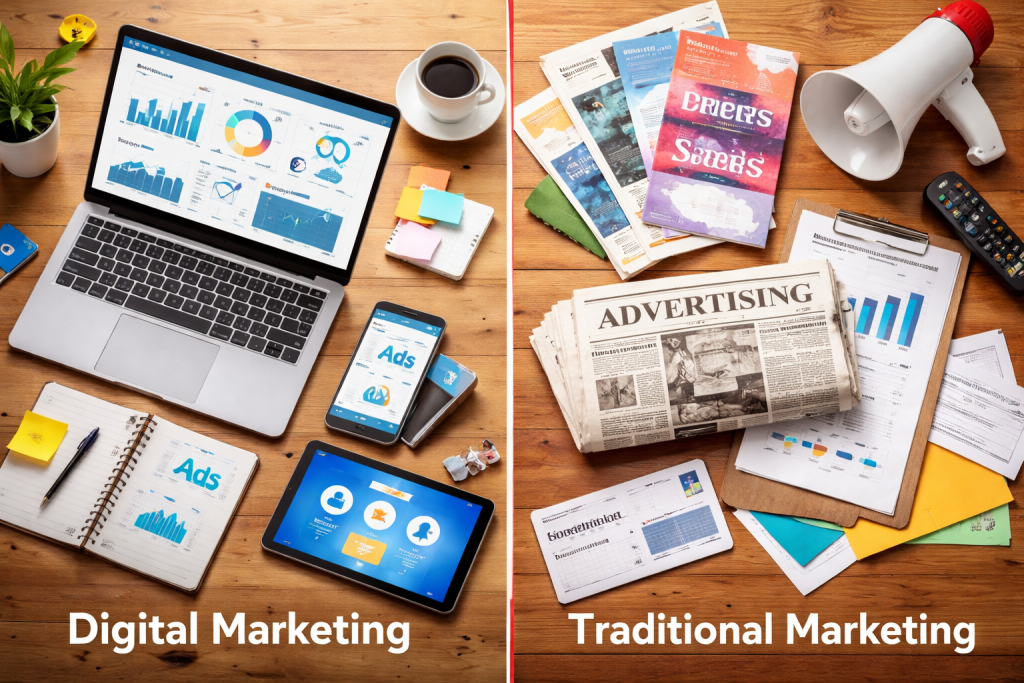
For centuries, marketing was all about getting your message out through limited, established channels. Think about it: town criers, newspaper ads, radio jingles, and television commercials were the cutting edge for a long time. These methods were effective enough for their era, but they lacked the precision and speed we’ve come to expect today.
Contents
- 1 How Traditional Marketing Got Its Start
- 2 The Digital Revolution and Its Impact
- 3 Traditional Marketing’s Broad Brushstrokes
- 4 Digital Marketing’s Laser Focus
- 5 Measuring Success in Traditional Marketing
- 6 The Power of Data in Digital Marketing
- 7 The Price Tag of Traditional Channels
- 8 Digital Marketing’s Scalability and Flexibility
- 9 Traditional Marketing’s One-Way Street
- 10 The Interactive Nature of Digital Marketing
- 11 The Enduring Power of Traditional Touchpoints
- 12 The Continuous Innovation in Digital Marketing
- 13 Creating a Unified Brand Experience
- 14 Using Each Channel Strategically
How Traditional Marketing Got Its Start
Before the internet, if you wanted to tell people about your business, you had a few options. You could print flyers, buy ad space in a local newspaper, or maybe even sponsor a local event. Radio and television advertising, once they came along, supercharged the reach of businesses, allowing them to hit massive audiences at once. This was a one-to-many broadcast model, where the message went out, and you hoped it stuck.
The Digital Revolution and Its Impact
The arrival of the internet changed everything. Suddenly, you could connect with people directly, not just broadcast to them. Websites became storefronts, email became a direct mail channel on steroids, and search engines turned into powerful discovery tools. This shift didn’t just add new channels; it fundamentally changed how we think about communicating with potential customers. It moved from a one-way street to a two-way conversation, opening up possibilities for personalization and immediate feedback that traditional methods couldn’t touch.
One of the biggest distinctions between digital and traditional marketing lies in their ability to reach specific audiences. Digital marketing offers unparalleled precision, while traditional methods often rely on broader strokes.
Traditional Marketing’s Broad Brushstrokes
With traditional marketing, you’re often casting a wide net. A television commercial, for example, reaches anyone watching that channel at that time, regardless of whether they’re interested in your product. A newspaper ad goes to everyone who buys that paper. While this can be good for general brand awareness, it means a significant portion of your message might be falling on deaf ears, leading to wasted effort and budget. It’s like trying to hit a bullseye with a shotgun; you might hit the target, but you’ll hit a lot of other stuff too.
Digital Marketing’s Laser Focus
Digital marketing, on the other hand, allows for incredible targeting. You can refine your audience based on demographics like age, geography, and income, but also delve into interests, online behavior, job titles, and even past purchasing habits. Imagine showing an ad for gardening tools only to people who have recently searched for gardening tips or followed gardening-related pages on social media. This level of precision ensures your message is seen by those most likely to be interested, drastically increasing the efficiency of your marketing efforts. This isn’t just about showing ads; it’s about connecting with people who are already partially receptive to what you offer.
Knowing if your marketing is actually working is crucial. This is another area where digital marketing often shines, offering more measurable and attributable results than its traditional counterpart.
Measuring Success in Traditional Marketing
Gauging the effectiveness of traditional campaigns can be a bit like detective work. You might track sales fluctuations after a billboard campaign or ask customers, “How did you hear about us?” after a radio ad. While these methods provide some insight, they often lack direct attribution. It’s difficult to definitively say how many sales were a direct result of a specific magazine ad versus other marketing efforts or even unrelated factors. This makes optimizing traditional campaigns in real-time a significant challenge. You can see general trends, but pinpointing specifics is harder.
The Power of Data in Digital Marketing
Digital marketing thrives on data. Everything from website visits and ad clicks to email open rates and conversion rates can be tracked, measured, and analyzed in real-time. This means you can see exactly which campaigns are performing well, which aren’t, and why. If an ad isn’t converting, you can pause it, tweak it, and relaunch it in a matter of minutes. This ability to continuously optimize and iterate based on hard data is incredibly powerful for maximizing your return on investment (ROI). You’re not guessing anymore; you’re seeing tangible results and making informed decisions.
Budget is almost always a factor when planning marketing initiatives. Both digital and traditional marketing have a range of costs, but the entry barrier and scalability often differ significantly.
The Price Tag of Traditional Channels
Traditional marketing often comes with a higher upfront cost. Buying a television commercial spot, a full-page ad in a national newspaper, or a series of billboards can be a significant investment. While these might reach a large audience, the cost per impression can be substantial, especially for smaller businesses. Production costs for high-quality TV or radio spots can also add up. These channels often require a bigger initial commitment and can be less flexible for smaller budgets.
Digital Marketing’s Scalability and Flexibility
Digital marketing offers much more flexibility in terms of budget. You can start with a very small budget on platforms like social media advertising or Google Ads and scale up as you see results. Many digital tools also allow for a “pay-per-click” model, meaning you only pay when someone actually interacts with your ad. This makes it more accessible for businesses of all sizes and allows for experimentation without breaking the bank. You can test different approaches with relatively small investments and then put more money behind what works. This democratic aspect of digital marketing has leveled the playing field for many small and medium-sized enterprises.
Beyond just getting your message out, how do you engage with your audience and build relationships? This is another key differentiator where digital marketing typically holds an advantage.
Traditional Marketing’s One-Way Street
Traditional marketing is largely a one-way communication channel. A print ad or a radio jingle doesn’t invite immediate feedback or conversation. While brand recognition can be built, the opportunity for direct interaction with customers is limited. You can put out a message, but you can’t easily hear back, at least not instantly. This makes it harder to foster a sense of community or directly address customer questions in real-time.
The Interactive Nature of Digital Marketing
Digital marketing, by its very nature, is designed for interaction. Social media platforms allow for comments, shares, and direct messages. Email marketing encourages replies and surveys. Websites can integrate live chat functions and comment sections. This constant back-and-forth allows businesses to build relationships with their audience, collect valuable feedback, and address concerns quickly. This interactivity can foster loyalty and create a more engaged customer base. It’s not just about selling; it’s about building a dialogue.
The marketing landscape is always shifting, and while digital marketing has undoubtedly gained significant ground, traditional methods aren’t entirely obsolete.
The Enduring Power of Traditional Touchpoints
Even in an increasingly digital world, traditional marketing still holds value. A well-placed billboard can still capture attention. A beautifully designed direct mail piece can stand out in a sea of digital messages. For certain demographics or industries, traditional channels remain highly effective. Think about local community events or print ads in niche magazines catering to specific hobbies—these can still be incredibly powerful if used strategically. The key is understanding when and where traditional methods make the most sense. There’s a tangible, physical quality to traditional media that digital can’t always replicate.
The Continuous Innovation in Digital Marketing
Digital marketing is a field of constant innovation. New platforms emerge, algorithms change, and consumer behaviors evolve. From the rise of AI in content creation and personalization to the growing importance of voice search and augmented reality experiences, the future of digital marketing promises even more sophisticated ways to connect with audiences. Keeping up with these trends is crucial for staying competitive in the digital space. It’s an ever-moving target, demanding continuous learning and adaptation.
Ultimately, the most effective marketing strategies often involve a blend of both digital and traditional approaches. It’s not necessarily an “either/or” situation, but rather about leveraging the strengths of each.
Creating a Unified Brand Experience
Imagine a customer seeing your ad on TV, then looking you up online, and finally visiting your physical store. A cohesive brand message across all these touchpoints creates a stronger, more memorable experience. When your traditional campaigns drive people to your website or social media, and your digital efforts reinforce your offline presence, you create a powerful synergy. This integrated approach ensures that no matter how someone encounters your brand, they get a consistent and positive impression.
Using Each Channel Strategically
The goal is to use each marketing channel for what it does best. Maybe traditional awareness campaigns are perfect for broader brand recognition, while digital channels are used for lead generation, customer support, and building engagement. A QR code on a print ad, for example, can bridge the gap between traditional and digital, seamlessly guiding customers from an offline experience to your online presence. By thoughtfully combining the two, you can maximize your reach, refine your targeting, and ultimately achieve your marketing objectives more effectively than relying on either method alone. It’s about building a comprehensive strategy that leverages all available tools to tell your brand’s story.

The Virelvo Editorial Team specializes in creating beginner-friendly digital marketing content designed to help individuals and small businesses grow online.