Boosting your website’s visibility isn’t a mystical art; it’s a strategic process, and at its core lies the power of on-page SEO. For beginners embarking on the journey of attracting more organic traffic, understanding and implementing page optimisation techniques is the foundational step. Without it, your website, no matter how beautifully designed or informative, risks becoming an undiscovered gem lost in the vast digital landscape. This comprehensive guide will demystify on-page SEO, providing you with a clear understanding, a practical checklist, and actionable strategies to bring your website to the forefront of search engine results.
On-page SEO refers to the practice of optimising elements on your website to improve its ranking in search engine results pages (SERPs). It’s about making your website more understandable and attractive to both search engine crawlers and, more importantly, human users. Think of search engines like Google as incredibly diligent librarians who want to provide the most relevant books to their patrons. On-page SEO is about ensuring your website’s “book” is perfectly catalogued, clearly labelled, and filled with high-quality, relevant information that matches the patron’s (user’s) query.
Contents
- 1 The Search Engine’s Perspective
- 2 The User’s Experience
- 3 Driving Organic Traffic
- 4 Building Authority and Trust
- 5 Enhancing User Experience
- 6 Page Title Optimization
- 7 Meta Description Enhancement
- 8 Header Tag Usage
- 9 Image Optimization
- 10 URL Structure
- 11 Keyword Integration
- 12 Content Depth and Quality
- 13 Readability and User Engagement
- 14 Keyword Research Basics
- 15 On-Page Keyword Placement Strategies
- 16 Semantic Keywords and Latent Semantic Indexing (LSI)
- 17 Site Hierarchy and Organization
- 18 Internal Linking Strategy
- 19 User-Friendly Navigation Menus
- 20 Key Performance Indicators (KPIs)
- 21 Search Engine Rankings
- 22 User Engagement Metrics
- 23 Conversion Rates
The Search Engine’s Perspective
Search engines crawl the internet, reading the content of web pages. They use complex algorithms to determine which pages are most relevant and authoritative for a given search query. On-page SEO involves deliberately crafting your content and website structure to communicate this relevance and authority directly. Ignoring these on-page signals is like handing the librarian a book with a blank cover and no table of contents—it’s going to be very difficult for them to catalogue and recommend.
The User’s Experience
While search engines are a critical audience, the ultimate goal of on-page SEO is to serve your human visitors. A well-optimised page is not only found by search engines but also provides a positive user experience. This means clear, engaging content, easy navigation, and fast loading times. By focusing on user needs, you naturally align with what search engines also value.
The digital realm is a crowded marketplace. For businesses, bloggers, and organisations, achieving visibility is paramount to connecting with their target audience and achieving their online goals. On-page SEO is the bedrock of this visibility strategy. It directly influences how well your website performs in organic search results, meaning the listings that appear without paid promotion.
Driving Organic Traffic
The primary benefit of strong on-page SEO is increased organic traffic. When your website ranks higher for relevant keywords, it means more people searching for those terms will encounter your site. This traffic is often highly qualified, as users are actively looking for information or solutions that you might provide. Unlike paid advertising, organic traffic is sustainable and can continue to drive visitors over time with consistent effort.
Building Authority and Trust
Search engines reward websites that demonstrate expertise, authoritativeness, and trustworthiness (E-A-T). On-page optimisation techniques contribute significantly to building these qualities. When your content is well-researched, comprehensive, and addresses user queries effectively, it signals to search engines that your website is a reliable source of information. This, in turn, enhances your site’s authority and builds trust with both search engines and users.
Enhancing User Experience
As mentioned, on-page SEO isn’t just about pleasing algorithms; it’s fundamentally about serving your audience. Optimising titles, meta descriptions, headings, and content readability directly impacts how users interact with your site. A positive user experience, characterised by easy navigation, clear information, and fast loading, leads to longer dwell times, lower bounce rates, and increased conversions—all factors that search engines interpret positively.
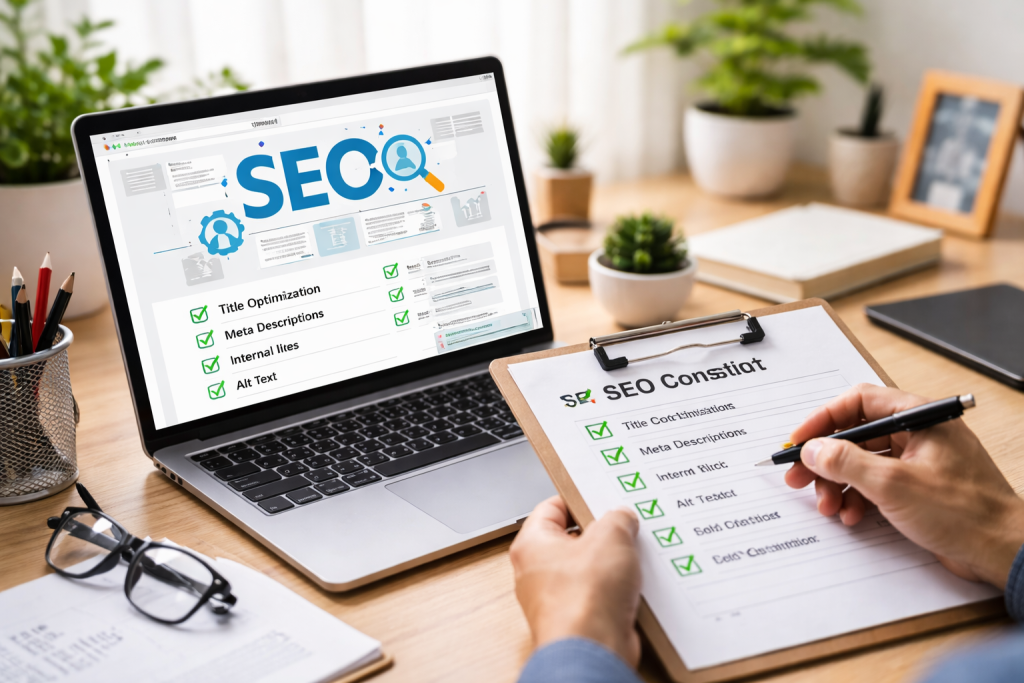
To effectively implement on-page SEO, it’s essential to have a structured approach. This checklist covers the fundamental on-page elements that every beginner should focus on to improve their website’s search engine performance.
Page Title Optimization
The page title is one of the most crucial on-page elements. It’s what users see in the browser tab and, most importantly, as the blue clickable link in the search results.
Crafting Compelling Titles
Your page title should be concise, descriptive, and include your primary keyword at the beginning if possible. Aim for a length of 50-60 characters to avoid truncation in search results. Make it enticing enough to encourage clicks.
Meta Description Enhancement
The meta description is the snippet of text that appears below the page title in the SERPs. While not a direct ranking factor, it plays a vital role in attracting clicks.
Writing Persuasive Descriptions
Your meta description should summarise the page’s content accurately and compellingly. Include your target keyword and a call to action if appropriate. Aim for around 150—160 characters.
Header Tag Usage
Header tags (H1, H2, H3, etc.) structure your content, making it easier for both users and search engines to understand the hierarchy of information on your page.
Structuring Content with Headers
Use a single H1 tag for your main page title, which should include your primary keyword. Subsequent headings (H2, H3) should logically break down your content and can incorporate secondary keywords.
Image Optimization
Images can enhance user experience and engagement, but unoptimised images can slow down your website.
Alt Text and File Names
Always use descriptive alt text for your images. This text is displayed if the image fails to load and is read by screen readers for visually impaired users. Search engines also use alt text to understand image content. Use descriptive file names for your images, incorporating relevant keywords where appropriate. Compress images to reduce file size without sacrificing quality.
URL Structure
Your URLs should be clear, descriptive, and user-friendly.
Creating SEO-Friendly URLs
Keep URLs short, use keywords, and ideally, include your primary topic. Avoid long strings of numbers or irrelevant characters. For example, it yourwebsite.com/on-page-seo-checklistis much better than the alternative.
Content is king, and for on-page SEO, it needs to be an optimised king. This involves more than just writing a few sentences; it requires a strategic approach to ensure your content is valuable, engaging, and discoverable by search engines.
Keyword Integration
Keywords are the terms and phrases people use when searching for information online. Integrating them naturally into your content is crucial for on-page SEO.
Natural Keyword Placement
Avoid keyword stuffing, which means unnaturally cramming keywords into your content. Instead, focus on using your primary and secondary keywords in a way that feels natural and conversational. Include them in your title, headings, introduction, body text, and conclusion.
Content Depth and Quality
Search engines prioritise comprehensive and valuable content that thoroughly answers user queries.
Delivering Value to Users
Aim to create content that is more informative and engaging than what currently exists in search results for your target keywords. Answer common questions, provide detailed explanations, and offer unique insights. The goal is to become the go-to resource for your topic.
Readability and User Engagement
Even the most informative content won’t be effective if users can’t read or understand it.
Improving Text Flow and Formatting
Use short paragraphs, bullet points (even within an article, not formal lists), subheadings, and clear language to make your content easy to scan and digest. Break up large blocks of text to improve readability. Ensure your content is free of grammatical errors and typos.
Keywords are the bridge between what users are searching for and the content you provide. Mastering their utilisation is fundamental to attracting the right audience to your website.
Keyword Research Basics
Before you can utilise keywords, you need to identify them. This involves understanding your target audience and what terms they are likely to use when searching for information related to your products, services, or content.
Identifying User Intent
Consider the intent behind search queries. Are users looking for information (informational intent), intending to buy something (transactional intent), or trying to navigate to a specific website (navigational intent)? Your content should align with this intent.
On-Page Keyword Placement Strategies
Once you have your target keywords, strategic placement is key.
Primary vs. Secondary Keywords
Your primary keyword is the main term you want to rank for on a specific page. Secondary keywords are related terms that broaden your reach and reinforce your topic. Include your primary keyword in your title tag, H1, and within the first 100 words of your content. Sprinkle secondary keywords naturally throughout the rest of the body text.
Semantic Keywords and Latent Semantic Indexing (LSI)
Modern search engines understand the context of your content, not just exact keyword matches. LSI keywords are semantically related terms that help search engines grasp the broader meaning of your page.
Expanding Keyword Vocabulary
By using synonyms and related terms, you signal to search engines that your content is comprehensive and authoritative on the subject. For example, if your primary keyword is “digital marketing”, LSI keywords might include “online advertising”, “social media marketing”, “content creation”, and “SEO strategies”.
A well-organised website not only improves user experience but also makes it easier for search engine crawlers to understand and index your content. This logical flow is a crucial aspect of on-page SEO.
Site Hierarchy and Organization
Think of your website as a pyramid. The homepage is at the apex, with broader categories branching out and then more specific pages within those categories.
Logical Categorization
Group your content into logical categories and subcategories. This helps users find what they’re looking for quickly and helps search engines understand the relationships between your pages. Aim for a flat site structure, meaning users shouldn’t have to click too many times to reach any page.
Internal Linking Strategy
Internal links are hyperlinks that point from one page on your website to another page on your website. They are incredibly powerful for SEO.
Connecting Related Content
Use internal links to guide users and search engine crawlers to relevant content on your site. When you mention a topic that is expanded upon in another post or page, link to it. This distributes “link equity” (authority) throughout your site and improves indexation. Ensure your anchor text (the clickable text of the link) is descriptive and relevant to the linked page.
Your navigation menus are the primary way users and search engines explore your website.
Intuitive Menu Design
Design clear, concise, and intuitive navigation menus. Users should be able to easily find the pages and information they need. Avoid overly complex or lengthy menus. A consistent navigation structure across all pages is also important.
Once you’ve implemented your on-page SEO efforts, it’s crucial to track your progress and analyse your performance to refine your strategy.
Key Performance Indicators (KPIs)
Several metrics indicate the success of your on-page SEO efforts.
Organic Traffic Growth
Monitor your website’s organic traffic trends using tools like Google Analytics. A steady increase in organic traffic for your target keywords indicates that your on-page optimisations are working. Pay attention to traffic driven to specific pages you’ve optimised.
Search Engine Rankings
Tracking your website’s rankings in SERPs for your target keywords is a direct measure of your on-page SEO effectiveness.
Utilizing Ranking Trackers
Use SEO tools to monitor your keyword rankings over time. Consistent improvement in rankings for your chosen keywords is a strong sign of success. Analyse which pages are improving and why.
User Engagement Metrics
How users interact with your content provides valuable insights into its effectiveness.
Bounce Rate and Time on Page
A low bounce rate (the percentage of visitors who leave your site after viewing only one page) and a high time on page (the average amount of time a user spends on your page) suggest that your content is engaging and meeting user expectations. Analyse these metrics for your optimised pages.
Conversion Rates
Ultimately, SEO is often tied to business goals. Tracking conversions from organic traffic is a critical measure of success.
Lead Generation and Sales
Monitor how many leads or sales are generated from organic search traffic. If your on-page SEO is effectively attracting qualified visitors, this should translate into increased conversions. Analyse which pages contribute most to conversions from organic search.
By diligently applying these on-page SEO principles and consistently monitoring your performance, you can significantly boost your website’s visibility, attract more qualified traffic, and ultimately achieve your online objectives. Remember that SEO is an ongoing process, and continuous learning and adaptation are key to long-term success.

The Virelvo Editorial Team specializes in creating beginner-friendly digital marketing content designed to help individuals and small businesses grow online.